
In the ever-evolving landscape of digital marketing, understanding your audience’s needs is the cornerstone of effective SEO. One concept that consistently separates successful strategies from stagnant ones is search intent—the underlying purpose behind a user’s query. Pair this with content mapping, the art of aligning your content to fulfill that intent, and you have a recipe for higher rankings, better engagement, and increased conversions. Let’s break down how these elements work together and how to leverage them for your brand.
What Is Search Intent? Why Does It Matter?
Search intent, often called “user intent,” refers to the goal a user has in mind when typing a query into a search engine. It’s the difference between someone searching “best budget laptops 2024” (looking for recommendations) and “buy Dell XPS 13” (ready to purchase). If your content doesn’t match what users truly want, even the most keyword-rich pages will struggle to rank or convert.
Google’s algorithms have grown sophisticated in interpreting intent, prioritizing content that satisfies users. Ignoring intent means competing for irrelevant keywords, wasting resources, and alienating your audience. For instance, a detailed product comparison guide won’t resonate with someone searching for “how to fix a cracked phone screen”—they want a quick tutorial, not a sales pitch.
The Four Types of Search Intent: A Deep Dive
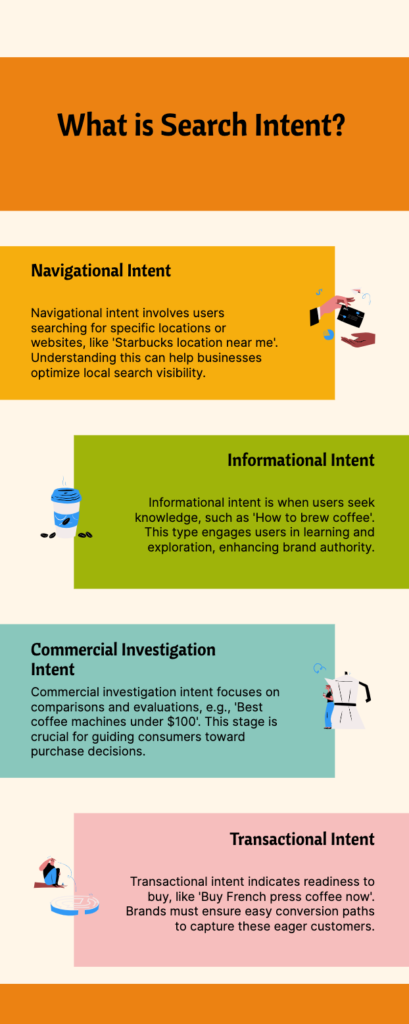
To create content that ranks and resonates, you must understand the four core types of search intent. These categories define why users search for specific terms and shape how search engines prioritize results.
1. Informational Intent
Definition: The user wants to learn, solve a problem, or answer a question.
Query Examples:
- “How to fix a leaky faucet”
- “What causes migraines?”
- “Benefits of intermittent fasting”
Content Strategy:
- Create detailed guides, tutorials, FAQs, or blog posts.
- Use clear headings (H2/H3) to break down steps or explanations.
- Optimize for featured snippets by answering questions concisely.
Best Practices:
- Avoid sales language—focus on education.
- Include videos or infographics for complex topics (e.g., “Step-by-step wiring diagram”).
- Update content regularly to reflect new trends (e.g., “2024 tax filing changes”).
2. Navigational Intent
Definition: The user aims to reach a specific website, page, or brand.
Query Examples:
- “Facebook login”
- “Apple customer support”
- “Nike Air Max product page”
Content Strategy:
- Optimize branded pages (homepage, login portals, contact pages).
- Secure featured snippets for branded queries (e.g., “Our official support line is…”).
- Use schema markup to highlight key details (e.g., business hours, contact info).
Best Practices:
- Monitor branded keywords for typos (e.g., “Facebok login”).
- Ensure your site’s search bar is visible and functional.
- Redirect old URLs to updated pages to prevent dead ends.
3. Transactional Intent
Definition: The user is ready to purchase, subscribe, or take action.
Query Examples:
- “Buy ergonomic office chair”
- “Spotify Premium discount”
- “Download resume template”
Content Strategy:
- Optimize product/service pages with clear CTAs (“Buy Now,” “Start Free Trial”).
- Create urgency with countdown timers or limited-stock alerts.
- Publish pricing pages or coupon hubs for deal-focused users.
Best Practices:
- Include trust signals: secure payment badges, return policies, and customer reviews.
- Use high-quality images and videos to showcase products.
- A/B test CTAs (e.g., “Get Started” vs. “Claim Your 50% Off”).
4. Commercial Investigation (Commercial Intent)
Definition: The user is comparing options before committing.
Query Examples:
- “iPhone 15 vs. Samsung Galaxy S23”
- “Best CRM software for startups”
- “Honda Accord 2024 reviews”
Content Strategy:
- Publish comparison guides, product roundups, or case studies.
- Highlight pros/cons, pricing tiers, and user ratings.
- Embed demo signup forms or free trial offers within comparison content.
Best Practices:
- Neutral tone: Avoid overly promoting your own brand unless it’s a “vs competitors” page.
- Use data-driven charts or tables for easy scanning.
- Target long-tail keywords (e.g., “affordable project management tools for remote teams”).
Visualizing Search Intent:
Image Recommendation: “Search Intent Quadrant” Infographic
- Design: Divide a square into four quadrants, each representing one intent type. Include icons, query examples, and content formats.
- Placement: After the “Four Types of Search Intent” section.
- Alt Text: “Infographic showing the four search intent types: informational, navigational, transactional, and commercial investigation.”
Why These Categories Matter:
Search engines like Google prioritize content that aligns with intent. For example:
- A transactional query like “buy organic coffee beans” will surface e-commerce pages, not blog posts about coffee farming.
- A commercial investigation query like “best noise-canceling headphones” will favor comparison articles over standalone product pages.
Pro Tip: Analyze the top 10 results for your target keyword. If 8/10 are product pages, Google views the intent as transactional—follow suit.
Common Mistakes to Avoid
- Misinterpreting Hybrid Intent: A query like “best laptops under $800” blends commercial investigation (comparisons) and transactional intent (readiness to buy). Create content that bridges both (e.g., a “Top 5” list with “Check Price” buttons).
- Ignoring Local Intent: Queries like “emergency plumber near me” require localized content with geo-specific keywords and Google Business Profile optimization.
- Overlooking Long-Tail Keywords: These often reveal clearer intent (e.g., “how to prune roses in spring” vs. “rose care”).
Content Mapping: Aligning Your Strategy with User Needs
Content mapping involves auditing your existing content and planning new pieces to directly address the intents above. Here’s how to do it effectively:
Step 1: Keyword Research with Intent in Mind
Use tools like SEMrush, Ahrefs, or AnswerThePublic to identify keywords and categorize them by intent. Look beyond search volume—analyze the top-ranking pages. Are they product pages, listicles, or how-to guides? This reveals what Google deems relevant.
Pro Tip: Long-tail keywords (e.g., “how to propagate succulents in water”) often have clearer intent than broad terms like “succulents.”
Step 2: Audit Existing Content
Evaluate your current content. Does that blog post titled “10 Running Shoes” target commercial investigation, but the content only lists products without comparisons? Update it to include pros/cons, pricing, and user reviews.
Real-World Example: A skincare brand noticed their guide on “acne treatments” ranked poorly. After revising it to include dermatologist tips and product recommendations (mixing informational and commercial intent), organic traffic grew by 70%.
Step 3: Create Content for Gaps
Fill gaps where your site lacks intent-aligned content. If competitors dominate transactional queries for “organic cotton sheets,” consider creating a dedicated product category page with clear CTAs instead of another blog post.
Step 4: Optimize for User Experience (UX)
Intent isn’t just about content—it’s about delivery. Ensure pages load quickly, are mobile-friendly, and easy to navigate. A user researching “meditation benefits” wants a calm, readable design; someone searching “emergency plumber near me” needs instant contact options.
Tools to Streamline the Process
- Google Analytics: Identify high-exit pages—these might indicate mismatched intent.
- Surfer SEO: Analyzes top-performing content structures for specific keywords.
- HubSpot’s Content Strategy Tool: Maps content to buyer journey stages (awareness, consideration, decision).
- Competitor Keyword Analysis: Uncover gaps in your strategy by studying competitors’ keyword targets and content gaps.
Putting It All Together
By mapping content to these four intent types, you can:
- Reduce Bounce Rates: Users stay longer when content matches their goals.
- Improve Rankings: Google rewards pages that satisfy intent.
- Boost Conversions: Align CTAs with user readiness (e.g., “Download Guide” for informational vs. “Buy Now” for transactional).
Action Step: Audit your top 10 pages. Are they optimized for the correct intent? If a blog targets transactional keywords, repurpose it into a product comparison guide or add a sales-focused CTA.
Conclusion: Intent Is the Future of SEO
Gone are the days of keyword stuffing. Today, winning SEO strategies prioritize the why behind searches. By mapping content to user intent, you build trust, reduce bounce rates, and drive meaningful engagement. Start by categorizing your keywords, auditing your assets, and creating content that feels less like a marketing ploy and more like a solution. Remember: When your content aligns with what users truly want, search engines can’t help but notice.
Final Thought: Next time you create a blog post or product page, ask yourself, “What is the user hoping to achieve here?” The answer will guide your content further than any algorithm update ever could.
Frequently Asked Questions
1. What is search intent, and why does it matter for SEO?
Answer: Search intent is the underlying goal behind a user’s search query (e.g., to learn, buy, or compare). It matters because Google prioritizes content that satisfies user needs. Ignoring intent leads to mismatched content, higher bounce rates, and lower rankings. For example, a blog post targeting the keyword “buy wireless headphones” (transactional intent) will fail if it’s a generic guide instead of a product page.
2. How do I determine the search intent of a keyword?
Answer:
- Analyze the top-ranking pages: Are they product pages, blogs, or videos?
- Use tools: SEMrush’s Keyword Overview or Ahrefs’ Keyword Explorer categorize intent.
- Check query language: Words like “how to” (informational) or “best” (commercial) hint at intent.
Example: If top results for “CRM software” are comparison guides, the intent is commercial investigation.
3. Can a single piece of content target multiple search intents?
Answer: Yes, but prioritize one primary intent. For example, a “Best Laptops for Graphic Design 2024” guide can:
- Primary Intent: Commercial investigation (comparing specs).
- Secondary Intent: Transactional (adding “Check Price” buttons).
Avoid overwhelming users—ensure the core intent is clear and actionable.
4. How often should I update content to align with search intent?
Answer: Audit content every 6–12 months. Intent evolves due to trends, algorithm updates, or market shifts. For instance:
- A 2022 post on “remote work tools” may need 2024 updates with AI collaboration software.
- Seasonal queries (e.g., “holiday gift ideas”) require annual refreshes.